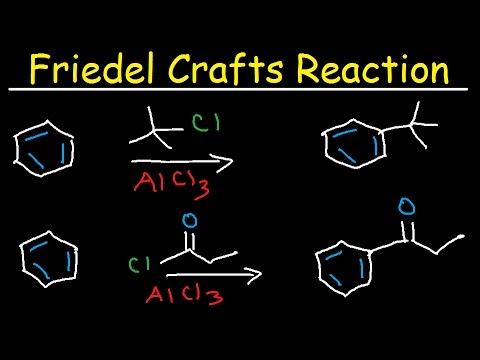
The Friedel-Crafts Alkylation is a set of reactions that uses electrophilic aromatic substitution and it was first established in the year 1877 by two famous chemists – Charles Friedel and James Crafts. This process involves the attaching of substituents to an aromatic ring.
They are of two types:
- Alkylation reactions. This is the process of transfer of the alkyl group from one molecule to another. The Alkyl group can be transferred as a free radical, carbanion, or carbene. Process of introducing one or more alkyl groups into a compound to increase the octane number.
- Acylation reactions. This is where we add an acyl group to a compound. The compound here is the acylating agent. Acyl halides are also known as acylating agents because they form strong electrophiles.
The above two are basic types for the Friedels Crafts Alkylation reaction process.
Here the alkylation of an aromatic ring with an alkyl halide happens by using a strong Lewis acid such as Aluminium chloride and ferric chloride. WE can also use another catalyst like MXn reagent.
For some primary alkyl halides, the complex formed with the lewis acid does not involve free carbonation.
It basically means the replacement of an aromatic proton with an alkyl group. This is done by an electrophilic attack on the aromatic ring by the process of the carbocation.
The biggest disadvantage for this product is more nucleophilic than the reactant because here the alkyl halides are the activators for the reaction. Sometimes there is a possibility for over alkylation. WE have three major disadvantages or limitations for this reaction and they are: Only certain alkylbenzenes can be made due to rearrangement of cations. When we use strong deactivating agents like nitrobenzene then this Friedel – Crafts Reaction does not work.
Friedel–Crafts dealkylation:
This process of alkylation can also be reversed. In a process of reaction of dealkylation, we can take some alkyl groups and here the alkyl groups are removed in the presence of protons or other Lewis acid. For example- if we add ethyl bromide to benzene there are some ortho and para substitution that happens after the first mono substitution happens. Here the alkyl group is the activating group. The actual product istriethybenzene. The alkyl groups are meta substituents.
We also see some thermodynamic reactions and these control the meta substitution with some hindrance. The final reaction product is the result of alkylation and dealkylation.
Scope and variations for this Reaction:
- The Gatterman reaction – with arene reactions with hydrocyanic acid
- The Gatterman reaction with Koch – synthesising the benzaldehyde from the compound benzene.
- The reaction of acylation which converts to alkylated product through the Clemmensen reduction process
- Arenes with nitriles described by HoubenHoesch reaction.
- The Scholl reaction where we have two arenes and they get together directly and also it called the Friedel-Craft arylation.
- In the Zincke Suhl reaction, the p -cresol is alkylated.
USES FOR THIS REACTION:
- This reaction is used for the synthesis of different kinds of Dyes. For example Xanthene Dyes.
- The Chloroform used for reaction with aromatic compounds in the presence of aluminium chloride gives off Triarylmethanes which are bright in colour and are aromatic.
- They are used for the formation of many biological compounds also DNA. They react a Lewis acid with an acyl halogen to form an ion. This is electrophilic and the extra electrons around can be used for stabilisation.
Limitations to this Alkylation process: The limitation is that they use methyl and hydride shifts. They will show an arrangement of three carbon chain what is used as a substituent. One way to resolve this is by Frieden-Crafts Acylation. We cannot use the alkyl or vinyl halides as a halide component in the Freidel-Craft reaction.
We can use acetic acid as a catalyst in this reaction here to get the ion from acetic acid that will be carried out in a solvent like dichloromethane and it will dissolve the salts but it will not react with it.
One other example we can take is Phenols which go through the process of Freidel Crafts Alkylation and this is why it’s best to use reagents that will help in getting the electrophile but not with sing a Lewis acid. The phenols here require harsher conditions namely temperatures etc.
Implications
In most states, the SPT is the predominant mechanism of insurance taxation. Under the Nonadmitted Reinsurance and Reform Act of 2010 (NRRA), an SPT may only operate in a single “home state” for policies covering the same insured or related insureds. Under Washington, the rules for registering captive insurers and paying taxes differ from those in the NRRA. A captive insurance company is subject to the Washington state tax senate bill 5315 if “one or more insureds have their principal place of business in Washington.”
